Ten Themes Driving the Future of Cybersecurity
by Gary Miliefsky
Cybersecurity is entering one of the most consequential periods in its history.
The industry is no longer dealing only with malware, ransomware, phishing, stolen credentials, and vulnerable infrastructure. Those threats remain, but they are now colliding with artificial intelligence, autonomous agents, quantum computing, identity fraud, geopolitical instability, software supply chain risk, cloud concentration, and increasingly sophisticated cybercriminal ecosystems.
For CISOs, the challenge is no longer simply stopping attacks.
It is understanding where risk is moving next.
The organizations that succeed over the next several years will be those that recognize cybersecurity is becoming less about isolated tools and more about continuous intelligence, resilience, trust, automation, and business survival.
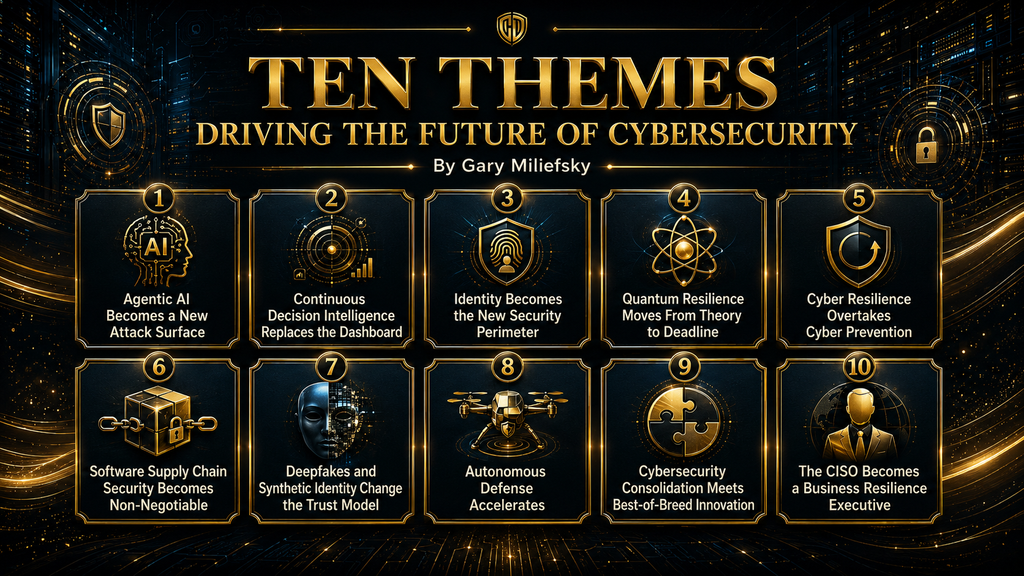
Here are ten themes I believe will define the next generation of cybersecurity.
1. Agentic AI Becomes a New Attack Surface
Generative AI changed how people interact with technology.
Agentic AI changes what technology is allowed to do.
AI agents can now make decisions, access systems, retrieve data, call APIs, execute workflows, write code, communicate with other agents, and perform tasks with limited human supervision.
That creates extraordinary productivity.
It also creates extraordinary risk.
An autonomous agent with the wrong permissions, compromised instructions, poisoned data, or manipulated context can become an attacker operating from inside the enterprise.
Security teams will increasingly need to answer questions such as:
- What is this agent authorized to do?
- Which data can it access?
- Which systems can it modify?
- What other agents can it communicate with?
- Can its behavior be observed in real time?
- Can it be stopped instantly?
- Has its behavior changed since the last software or model update?
The future enterprise may contain thousands of digital workers.
Every one of them will need an identity, permissions, monitoring, behavioral controls, and governance.
AI security is rapidly becoming identity security, application security, data security, and behavioral security at the same time.
2. Continuous Decision Intelligence Replaces the Dashboard
Security organizations already have dashboards.
Lots of them.
The problem is that dashboards generally tell us what happened.
CISOs increasingly need systems that help determine what matters now and what should happen next.
Security teams are drowning in telemetry from endpoint tools, SIEM platforms, vulnerability scanners, identity systems, cloud platforms, threat intelligence feeds, attack surface management systems, SaaS applications, and countless other sources.
The next major evolution will be the emergence of continuous cybersecurity decision intelligence.
Instead of another pane of glass, these platforms will continuously correlate risk, threats, assets, vulnerabilities, identity, business importance, and security controls to answer a much more important question:
What should we do first?
The winners in this category will reduce complexity rather than add to it.
3. Identity Becomes the New Security Perimeter
The traditional network perimeter continues to disappear.
Employees work everywhere.
Applications live everywhere.
Data lives everywhere.
Machines communicate with other machines.
AI agents access corporate systems.
Contractors, partners, APIs, workloads, service accounts, devices, bots, and autonomous software all require identities.
Attackers understand this.
That is why credential theft, session hijacking, MFA bypass, privilege escalation, token theft, and identity abuse remain among the most effective methods of entering an organization.
The cybersecurity perimeter of the future will increasingly revolve around one concept:
Who or what is requesting access, and should we trust it right now?
Identity will become dynamic.
Access decisions will depend not only on credentials but on behavior, device condition, location, privilege, workload, context, risk, and intent.
Zero Trust will evolve from architecture into continuous verification.
4. Quantum Resilience Moves From Theory to Deadline
For years, quantum computing was treated as something cybersecurity leaders could worry about later.
Later is arriving.
The concern is not that a cryptographically relevant quantum computer will suddenly appear tomorrow morning.
The concern is that organizations possess enormous amounts of encrypted information that may remain valuable for decades.
Attackers can steal encrypted information today and preserve it for future decryption.
This is commonly described as:
Harvest now, decrypt later.
Governments, financial institutions, defense organizations, technology companies, healthcare providers, and critical infrastructure operators therefore need to understand where vulnerable cryptography exists throughout their environments.
That includes:
- Certificates
- VPNs
- PKI
- APIs
- Embedded systems
- Software
- Cloud services
- Databases
- Backups
- IoT devices
- Industrial systems
Quantum resilience will become a board-level issue because replacing cryptography across a large enterprise can take years.
Crypto-agility may ultimately prove as important as the specific post-quantum algorithms organizations deploy.
5. Cyber Resilience Overtakes Cyber Prevention
No serious CISO believes every attack can be prevented.
The better question is:
Can the organization continue operating when prevention fails?
Cyber resilience will become one of the most important measures of security maturity.
Organizations will increasingly evaluate:
- Recovery time
- Business continuity
- Segmentation
- Backup integrity
- Identity recovery
- Cloud failover
- Crisis communications
- Incident decision making
- Executive readiness
- Supply chain alternatives
Boards will become less interested in hearing that an organization has purchased dozens of security products.
They will want to know:
If our most important systems go down tomorrow, how long until we are operating again?
That is a very different conversation.
6. Software Supply Chain Security Becomes Non-Negotiable
Modern software is assembled, not simply written.
Applications depend upon enormous ecosystems of open-source libraries, packages, containers, APIs, third-party services, development pipelines, code repositories, and software components.
An attacker no longer needs to attack 5,000 enterprises individually.
Compromise one widely used supplier and the attacker may inherit thousands of downstream targets.
Software bills of materials will become increasingly important, but visibility alone is not enough.
Organizations will need to understand:
- What components are actually running?
- Which components are reachable?
- Which vulnerabilities are exploitable?
- Which dependencies are trustworthy?
- Has software been tampered with?
- Can malicious code be detected before execution?
- How quickly can compromised components be replaced?
Supply chain security will increasingly converge with application security, code intelligence, runtime protection, and continuous verification.
7. Deepfakes and Synthetic Identity Change the Trust Model
One of the most disruptive consequences of artificial intelligence may have very little to do with hacking computers.
It has to do with hacking people.
Voice cloning, synthetic video, deepfakes, AI-generated documents, fabricated identities, and highly personalized social engineering are becoming extraordinarily convincing.
Imagine receiving a video call from your CEO requesting an urgent wire transfer.
You see the CEO.
You hear the CEO.
The CEO knows internal company information.
And none of it is real.
Organizations will increasingly need mechanisms for authenticating humans, communications, transactions, and digital content.
Verification will become embedded into business processes.
The question will no longer be:
Does this look real?
The question will become:
Can this be cryptographically, behaviorally, or procedurally verified?
Trust itself is becoming a cybersecurity problem.
8. Autonomous Defense Accelerates
Attackers are already using automation and artificial intelligence.
Defenders must do the same.
Security operations centers cannot continue scaling simply by hiring more analysts to review more alerts.
The mathematics do not work.
AI-assisted security operations will increasingly automate:
- Investigation
- Threat hunting
- Triage
- Correlation
- Malware analysis
- Identity analysis
- Vulnerability prioritization
- Response recommendations
- Containment
- Reporting
Eventually, some defensive actions will occur autonomously.
That will create its own governance challenge.
Organizations will need to determine how much authority defensive AI should possess.
Can an AI isolate a server?
Disable a user?
Block a supplier?
Revoke credentials?
Shut down production?
Autonomous security will require carefully designed guardrails because the cost of a mistaken defensive action can sometimes rival the cost of an attack.
9. Cybersecurity Consolidation Meets Best-of-Breed Innovation
CISOs face a difficult contradiction.
They want fewer tools.
But the most innovative cybersecurity capabilities often emerge from smaller specialized companies.
Large platforms therefore have an advantage because they simplify procurement, integration, and management.
Innovators have an advantage because they frequently solve emerging problems faster.
This tension will reshape the cybersecurity market.
The winners may not necessarily be companies with the most features.
They will be companies capable of demonstrating:
- Measurable operational value
- Fast integration
- Strong interoperability
- Reduced complexity
- Clear business outcomes
- Real-world efficacy
The industry is moving away from buying technology because it sounds impressive.
CISOs increasingly want proof.
Does it work?
Does it reduce risk?
Does it save time?
Does it make the security organization better?
Those questions will separate innovation from noise.
10. The CISO Becomes a Business Resilience Executive
Perhaps the largest transformation is happening to the CISO role itself.
Cybersecurity is no longer a technical function buried somewhere inside IT.
Cyber risk can stop manufacturing.
Freeze financial transactions.
Disrupt hospitals.
Ground aircraft.
Interrupt energy production.
Expose intellectual property.
Damage brands.
Trigger regulatory action.
Destroy customer confidence.
Cybersecurity has become business risk.
That means tomorrow’s most successful CISOs will need to understand far more than technology.
They will need fluency in:
- Business strategy
- Finance
- Regulation
- Risk
- Artificial intelligence
- Crisis management
- Communications
- Insurance
- Supply chains
- Geopolitics
- Board governance
The CISO is evolving from chief security technologist into chief digital resilience strategist.
That transformation may ultimately be more important than any individual cybersecurity technology.
The Bigger Picture
These ten themes are connected.
Agentic AI creates new identities.
New identities create new attack surfaces.
AI-driven attacks require autonomous defense.
Autonomous defense requires continuous decision intelligence.
Quantum computing challenges cryptography.
Supply chain attacks challenge software trust.
Deepfakes challenge human trust.
Cloud concentration challenges resilience.
And all of it lands on the desk of the CISO.
That is why the future of cybersecurity will not be defined by a single breakthrough technology.
It will be defined by the ability to continuously understand risk, verify trust, prioritize decisions, contain threats, recover rapidly, and keep the business operating.
The companies building that future will not simply sell cybersecurity products.
They will help organizations answer the most important question in modern business:
Can we continue to operate safely in a world where everything is connected, intelligent, autonomous, and under attack?
For the cybersecurity industry, that is the challenge.
For innovators, it is also one of the greatest opportunities we have ever seen.
Gary S. Miliefsky
Publisher, Cyber Defense Magazine
Cyber Defense Media Group